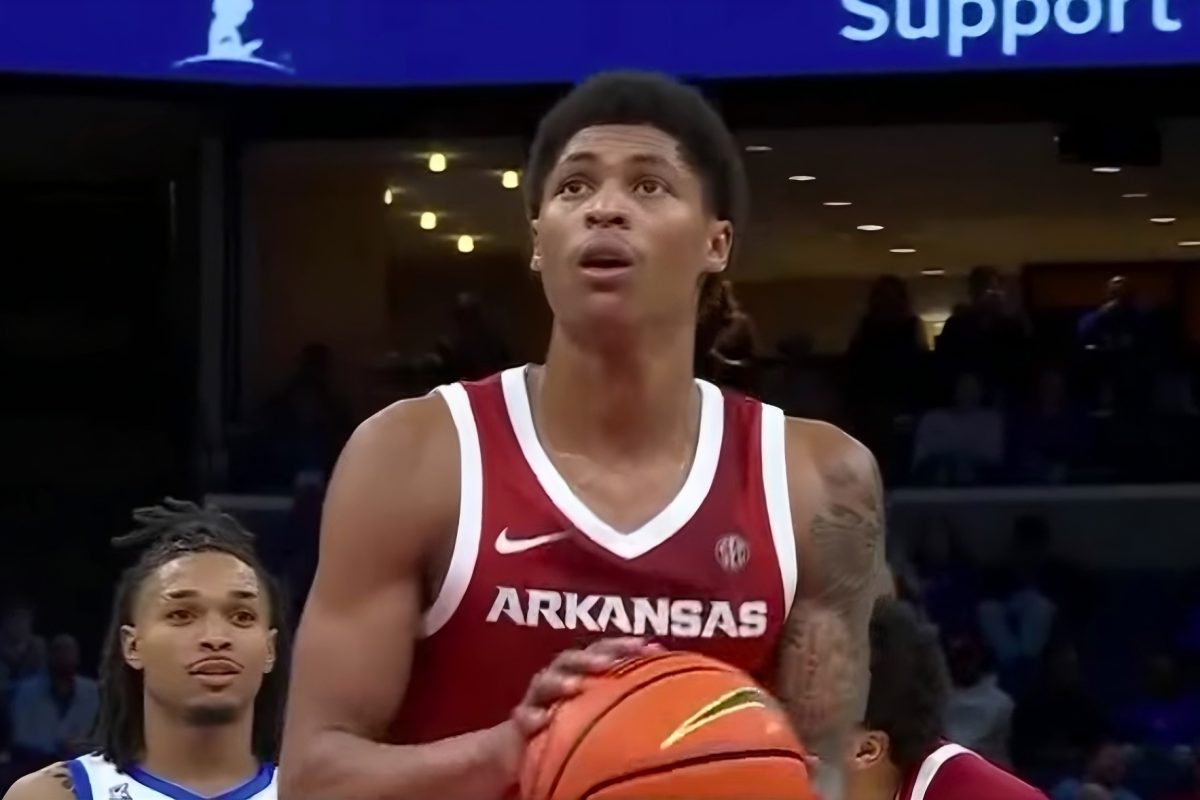
The Los Angeles Lakers hosted Arkansas guard Meleek Thomas for a pre-draft workout this week, evaluating a perimeter option projected to be available near their first-round selection at No. 25 overall, according to Evan Sidery.
Thomas is part of the Lakers’ broader draft process as they weigh rotation depth around an established core led by Luka Doncic and Austin Reaves.
Thomas, a 2025–26 SEC freshman, averaged 15.6 points across 37 games while shooting 43.5% from the field and 41.6% from three on 5.3 attempts per game. He logged 30.5 minutes per contest and posted 2.5 assists, 3.8 rebounds, and 1.5 steals, combining perimeter scoring efficiency with secondary playmaking and defensive activity.
His scoring profile is anchored by movement shooting and catch-and-shoot efficiency, with 2.2 made threes per game accounting for a significant share of his production. Thomas also converted 84.3% at the free-throw line, supporting the shooting indicators that made him a viable late-first-round evaluation for teams seeking spacing without heavy usage demands.
The Lakers enter the draft holding the No. 25 pick after finishing the 2025–26 regular season 53–29 and advancing to the Western Conference semifinals. Los Angeles relied heavily on a top-heavy offensive structure, with Doncic averaging 33.5 points and 8.3 assists in 35.8 minutes per game, while Reaves added 23.3 points and 5.5 assists across 51 appearances.
Thomas’ role at Arkansas featured on-ball reps in secondary actions rather than full-time initiation duties, with 2.5 assists per game and a 1.0 turnover average indicating controlled decision-making within structured offense. His 1.5 steals per game also reflect defensive disruption in passing lanes, though his 0.2 blocks and modest rebounding numbers suggest a guard-oriented defensive impact profile.
The pre-draft workout comes as Los Angeles continues to evaluate rotational cost efficiency. Reaves’ next contract is expected to exceed $40 million annually, tightening long-term roster flexibility and increasing the importance of controlled rookie-scale contributors.